
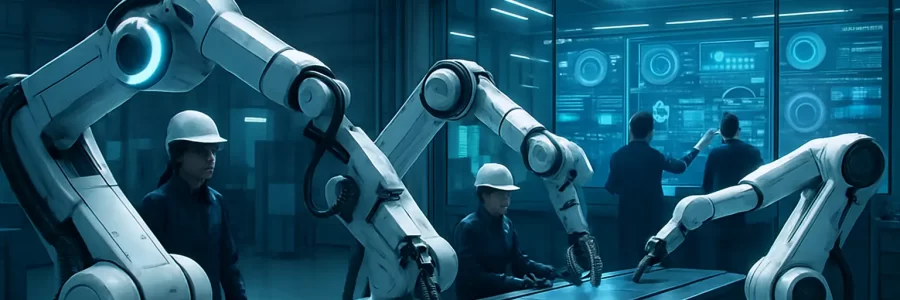
In a world where progress drives every decision, the alliance between process automation and robotics is redefining how industries operate. This isn’t just about machines or code—it’s about a complete reimagination of efficiency, precision, and human potential.
This guide explores the growing relationship between process automation and robotics, and how together, they are transforming the way industries think, build, and evolve.
Introduction: Entering the Age of Intelligent Systems
Businesses across sectors are facing mounting pressure to scale operations, eliminate inefficiencies, and reduce costs—without sacrificing quality or speed. The answer lies in two converging forces: process automation and robotics. Together, they form the foundation of an intelligent, responsive, and highly optimized industrial future.
Process Automation: The Blueprint for Efficiency
Process automation involves using technology to perform repetitive, rule-based tasks with little to no human intervention. It reduces dependency on manual input, lowers the risk of error, and enables organizations to streamline workflows across functions.
Beyond simple task execution, process automation is about designing systems that think, act, and optimize in real time. It’s the invisible engine powering modern enterprises, making operations faster, smarter, and leaner.
Robotics: Giving Automation a Physical Form
Where process automation operates in the digital realm, robotics gives it form in the physical world. Robots are machines designed to perform tasks with speed, accuracy, and consistency—often in environments that are hazardous, repetitive, or sensitive.
Modern robotics combines mechanical engineering, artificial intelligence, and data processing to build systems that not only follow instructions, but also adapt and learn. From factory floors to hospital operating rooms, robots are extending the reach of automation into nearly every aspect of industrial life.
The Limitations of Manual Operations
Traditional processes come with real constraints. Manual labor introduces variability. Repetitive tasks increase the chance of errors. Human fatigue limits speed and precision. And as demand scales, so do inefficiencies.
Industries relying solely on manual methods often face increased operational costs, reduced throughput, and difficulty adapting to real-time demands. Whether in manufacturing, logistics, or healthcare, outdated systems become bottlenecks to innovation.
Why Robotics Complements Automation
Automation defines the logic. Robotics brings it to life. While automation enables systems to make decisions, robotics executes those decisions physically.
In manufacturing, robotic arms assemble components with millimeter-level precision. In healthcare, surgical robots enhance a surgeon’s dexterity and accuracy. In logistics, autonomous robots navigate warehouses, optimizing inventory management and delivery routes.
This integration transforms automation from software into physical performance—fast, reliable, and infinitely scalable.
Key Elements That Drive Robotic Automation
At the heart of every robotic system are three core components.
Sensors act as the robot’s senses, collecting real-time data from its surroundings—temperature, proximity, pressure, vision, and more.
Actuators are the robot’s muscles. They convert electrical signals into motion—lifting, rotating, gripping, or shifting based on input.
Control systems function as the brain. They process information, make decisions, and direct actions based on programmed logic and environmental feedback.
All of this is governed by software—precise code that ensures synchronized, intelligent action. This software defines the tasks, the thresholds for operation, and the conditions for adaptation, making robotic automation dynamic and intelligent.
Benefits That Redefine Industrial Performance
The integration of robotics and automation leads to tangible gains.
Productivity increases exponentially as systems operate continuously without fatigue, break times, or slowdown.
Errors are drastically reduced due to robotic precision and system standardization, eliminating the inconsistencies of manual workflows.
Cost-efficiency becomes a long-term advantage. Although the initial investment in automation may be high, the reduced labor cost, improved accuracy, and minimized waste provide a rapid and measurable return.
Quality and consistency are maintained at every level. Robots execute instructions identically every time, delivering products that meet exacting standards—batch after batch.
Safety is enhanced. Robots operate in environments unsafe for humans—extreme heat, toxic chemicals, confined spaces—ensuring risk is transferred from people to machines.
The human workforce is empowered. Automation frees professionals from monotonous tasks, allowing them to focus on strategy, problem-solving, and creative innovation. It’s not about replacement; it’s about collaboration.
Real-World Success in Action
Amazon’s fulfillment centers are a living demonstration of automation at scale. Robots navigate thousands of shelves, retrieving items with speed and precision, while human workers manage oversight and quality control. The result is unmatched operational efficiency and delivery speed.
Tesla’s manufacturing facilities use robotic automation to assemble vehicles with pinpoint precision. From welding to painting, robotics ensures consistent quality and scalability—supporting Tesla’s mission of building the future of mobility.
These examples are not aspirational. They’re operational. And they’re proof that robotic process automation is not a concept—it’s a competitive advantage.
Challenges to Consider Before Adopting RPA
Despite the promise of automation, implementation must be strategic.
The cost of deployment can be high, especially for smaller organizations. Integrating with legacy systems often requires custom solutions. Cybersecurity becomes a major consideration as connected robots handle sensitive data and tasks.
Skill gaps may emerge. Employees need training to work alongside machines, interpret data, and manage automated workflows. Change management becomes critical to align teams, processes, and expectations.
Automation also introduces system dependencies. If something fails, it can halt production at scale. That’s why redundancy, maintenance planning, and monitoring systems must be part of any deployment strategy.
A Glimpse Into the Future
The next chapter of automation involves more than machines—it’s about intelligence, agility, and co-creation.
Artificial intelligence is enabling robots to adapt to new conditions, learn from data, and improve performance over time. Collaborative robots are entering human workspaces, designed to safely interact and assist.
Hyperautomation is the next evolution—automating not just tasks but entire systems, using AI, machine learning, and advanced analytics.
The future isn’t about machines replacing people. It’s about machines and people creating more—together.
Conclusion: The Future is Automated, and It’s Now
Process automation and robotics are not trends. They’re transformational forces. They enable industries to scale, adapt, and thrive in a rapidly evolving world.
The question is no longer if automation is coming—it’s how fast you can align your strategy to embrace it.
In this new era, success belongs to those who understand one core truth:
Automation doesn’t replace people.
It elevates them.